The Fundamental Gap Between Identification and Timing
A scan query answers a specific descriptive question across a defined universe of symbols at one discrete point in time. It measures whether specific observable parameters match logical constraints, leaving open the broader contextual questions that determine execution viability.
When market screeners return twenty symbols matching conditions such as relative volume expansion and multi-period moving average alignment, beginners often assume the engine has issued twenty buy orders. In systematic research, however, a screener functions like a library search catalog. Querying an index for publications discussing macroeconomic cycles returns a list of titles, not a synthesized policy paper. In the exact same manner, screener queries aggregate symbols where mathematical footprints exist, without examining spread quality, corporate filings, pending earnings, or intra-bar order flow exhaustion.
Quantitative screeners necessarily discard micro-structure details to process thousands of assets concurrently. An indicator crossover or volatility band compression flags mathematical alignment, yet the price may have achieved that state through abnormal pre-market gaps, split recalculation quirks, or singular block prints. Without manual chart inspection and liquidity verification, blind execution upon scan generation introduces substantial false positive exposure.
Refine Your Multi-Step Review Protocol
Discover our structured visual inspection framework designed to examine scan outputs for structural integrity before drawing conclusions.
Why Mechanical Filters Ignore Execution Realities
A screener evaluation evaluates static snapshots or end-of-bar aggregations. While mathematical syntax captures historical values up to the calculation timestamp, execution requires forward-looking market interaction. A stock might satisfy a strict momentum rule while simultaneously printing an illiquid five-cent bid-ask spread that renders standard execution impractical.
- Primary Purpose
- Universe Reduction
- Time Dimension
- Historical / Aggregated Snapshot
- Contextual Awareness
- Rule-Blind to Microstructure
- Required Next Step
- Manual Visual Verification
Screeners operate on mathematical reductionism. A query cannot assess whether market participants are reacting to scheduled conference call commentary or whether an abnormal volume bar resulted from index rebalancing. Treating an automated candidate list as a trade signal ignores the vital bridge between quantitative discovery and qualitative verification.
“A screener isolates where to look in a crowded market universe. Deciding whether the observation confirms an orderly setup remains the exclusive job of rigorous manual inspection.”
Navigating the Workbook Inspection Sequence
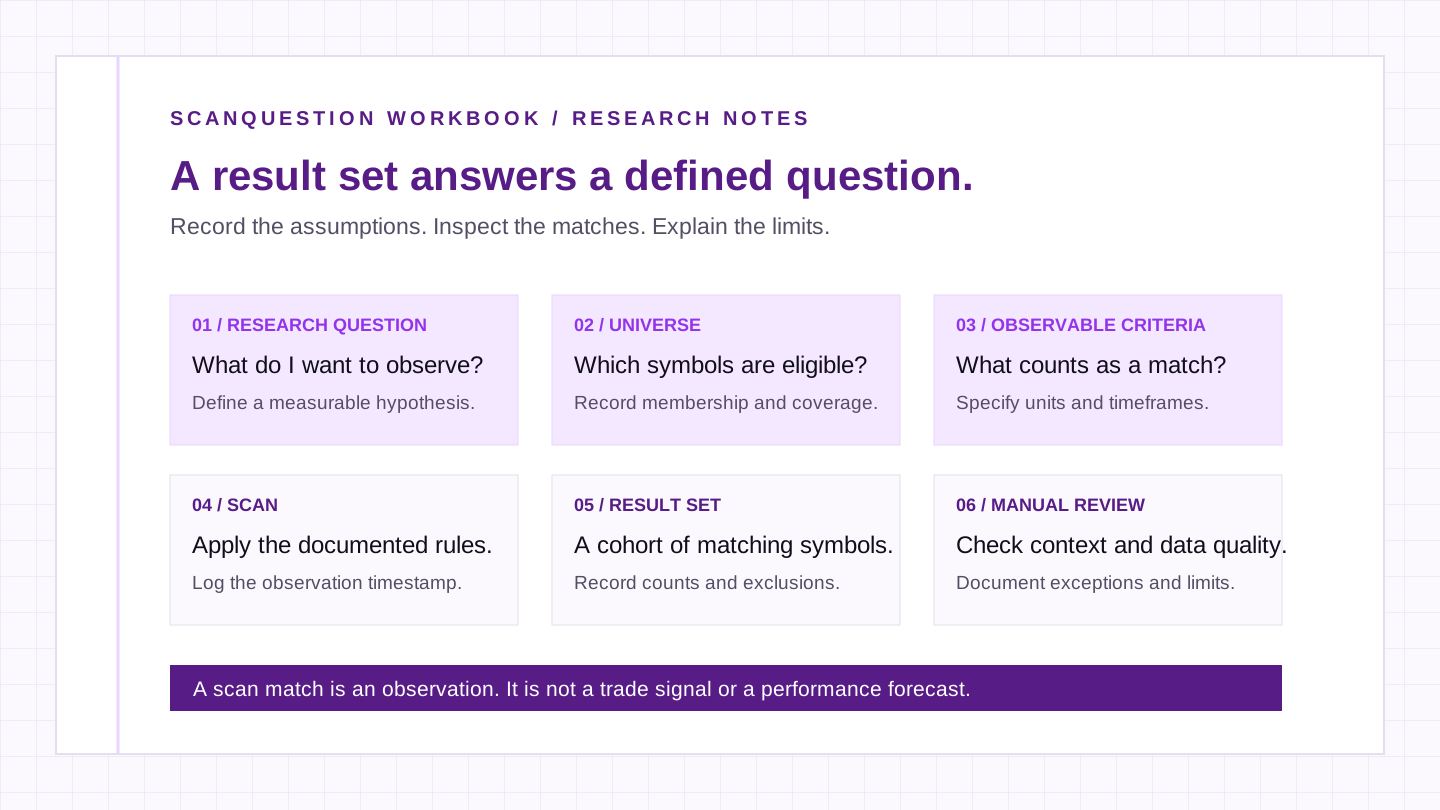
Developing confidence in screener design requires an appreciation for iterative evaluation. When an analytical scan yields an unexpected candidate, the researcher does not execute orders or discard the screener; instead, the researcher investigates the underlying data mechanics that produced the entry.
Following this sequential roadmap ensures that screeners stay rooted in empirical study. By isolating the distinct responsibility of each stage—from research question through manual review—analysts avoid the trap of overloading screener syntax with premature exit, risk, or trade management logic.
Diagnostic Checklists and Workbook Cross-References
Synthesizing screener outputs into structured research findings demands strict separation between exploratory queries and actionable conclusions. Review the companion workbook modules below to trace how universe definitions, relative volume baselines, and multi-timeframe aggregation combine to build reliable educational screening pipelines.