The Mathematical Mirage of Timeframe Invariance
Screening filters operate on mathematical definitions that assume structural consistency, yet price distributions mutate drastically whenever continuous auction transactions collapse into arbitrary timeframe buckets.
Every technical metric calculates its output from discrete sampling points defined by open, high, low, and close values. When an analyst transfers a screener rule from daily candles to sixty-minute or weekly aggregations, the calculation does not simply change scale. It reconfigures the sample variance, alters rolling averages, and shifts threshold sensitivities. A 20-period moving average on an hourly chart encompasses twenty hours of continuous market interaction, whereas the same formula on a daily chart incorporates nearly an entire calendar month of macroeconomic news, quarterly announcements, and institutional repositioning.
Intraday timeframes also incorporate session opening gaps, mid-day liquidity troughs, and closing auction volume spikes that heavily distort rolling standard deviations. A momentum oscillator computed over fourteen 5-minute bars measures microstructure bid-ask noise rather than broad directional consensus. When a scanner applies identical absolute thresholds across both daily and intraday intervals, it generates massive false-positive sets composed almost entirely of short-term noise masquerading as structural momentum.
Audit Your Multi-Period Aggregation Rules
Review how interval compression and synthetic candle sampling alter your screener population before applying execution rules.
Aggregation Lag and the Perils of Unclosed Interval Bars
Market screeners process incoming market feeds through two distinct evaluation models: closed-candle evaluation and real-time intra-bar evaluation. This operational distinction determines whether scan results represent verifiable historical states or transient intra-interval artifacts. If a scanner evaluates a weekly moving average crossover on Tuesday afternoon, it contrasts an incomplete 16-hour candle against historical five-day aggregates. The apparent condition frequently evaporates before the weekly candle officially closes on Friday.
- Sampling Period Multiplier
- Daily vs 60m: 6.5x Ratio
- Intraday Noise Saturation
- Severe Under 15m Intervals
- Lookahead Bias Vulnerability
- High on Unfinished Bars
- Maximum Formation Lag
- 100% of Aggregation Window
Conversely, enforcing strict bar-close confirmation introduces systematic latency. By the time a monthly Bollinger Band contraction or weekly trend break confirms at the closing bell, the price displacement that prompted the research question has often completed its primary impulse. Multi-timeframe screening requires rigorous synchronization to avoid pairing stale macro observations with hyper-sensitive micro triggers.
“Changing the aggregation period does not merely alter the zoom level; it reconstructs the mathematical foundation of every indicator in the query.”
Aligning Research Questions with Measurement Cadence
To preserve metric validity across heterogeneous timeframes, researchers must harmonize their analytical inquiry with the cadence of the auction mechanism under review. An inquiry exploring sustained institutional volume expansion requires daily or weekly parameters, insulating the scan from erratic intraday liquidity spikes caused by algorithmic execution slicing.
When combining conditions across multiple time horizons—such as filtering for weekly macro trend alignment alongside daily volatility contraction—the screener syntax must explicitly lock parent conditions to completed historical intervals. This rule prevents live repainting and ensures that candidate tickers satisfy the exact theoretical assumptions of the study.
Nested Multi-Timeframe Verification Checklists
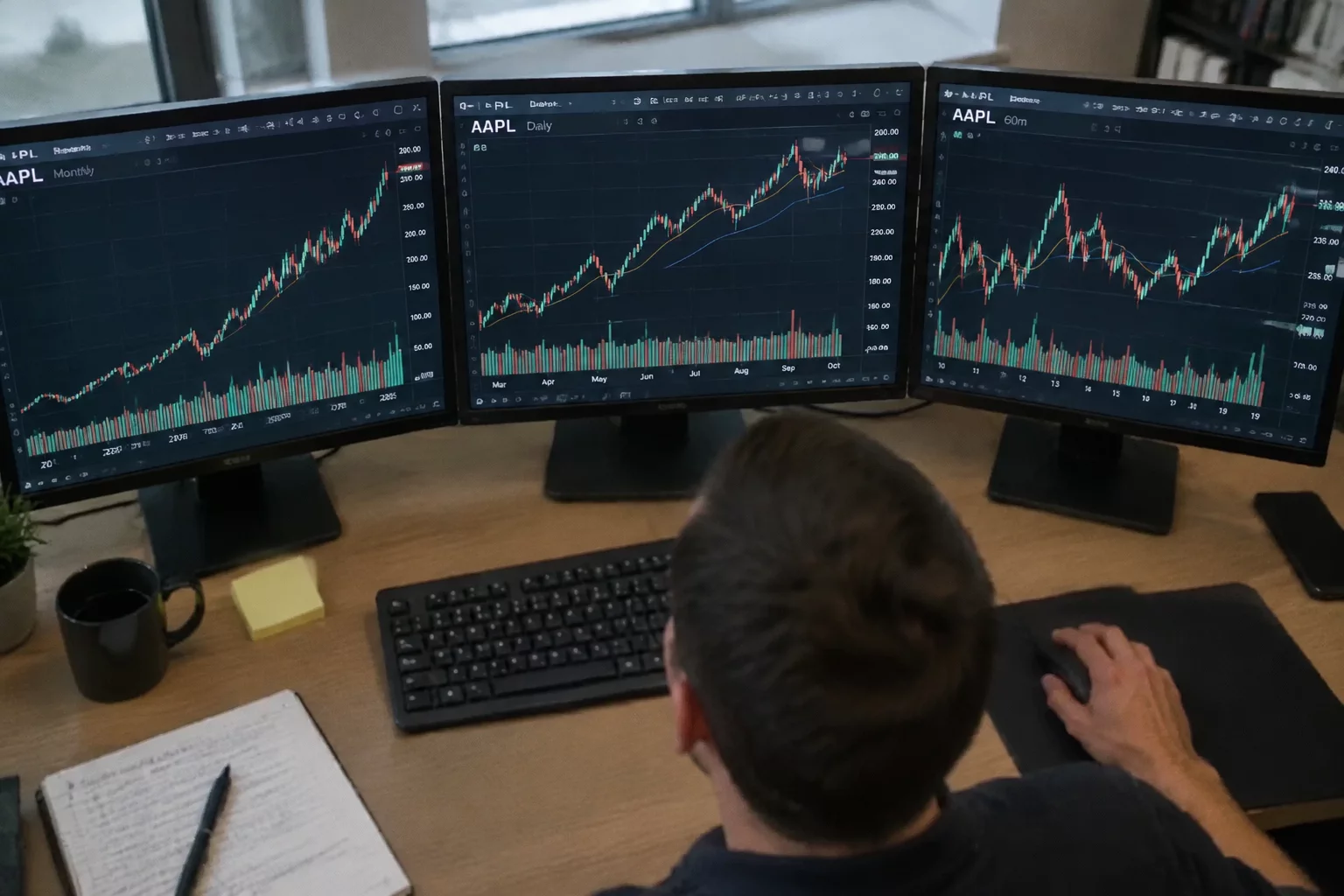
Post-scan manual review represents the essential checkpoint before acting on screener outputs. By visually auditing candidate charts across three aligned timeframe panels, researchers quickly discover whether a pass resulted from genuine structural progression or brief intra-bar volatility anomalies. A structured verification routine protects screener output integrity and reveals syntax flaws before analytical conclusions are formed.