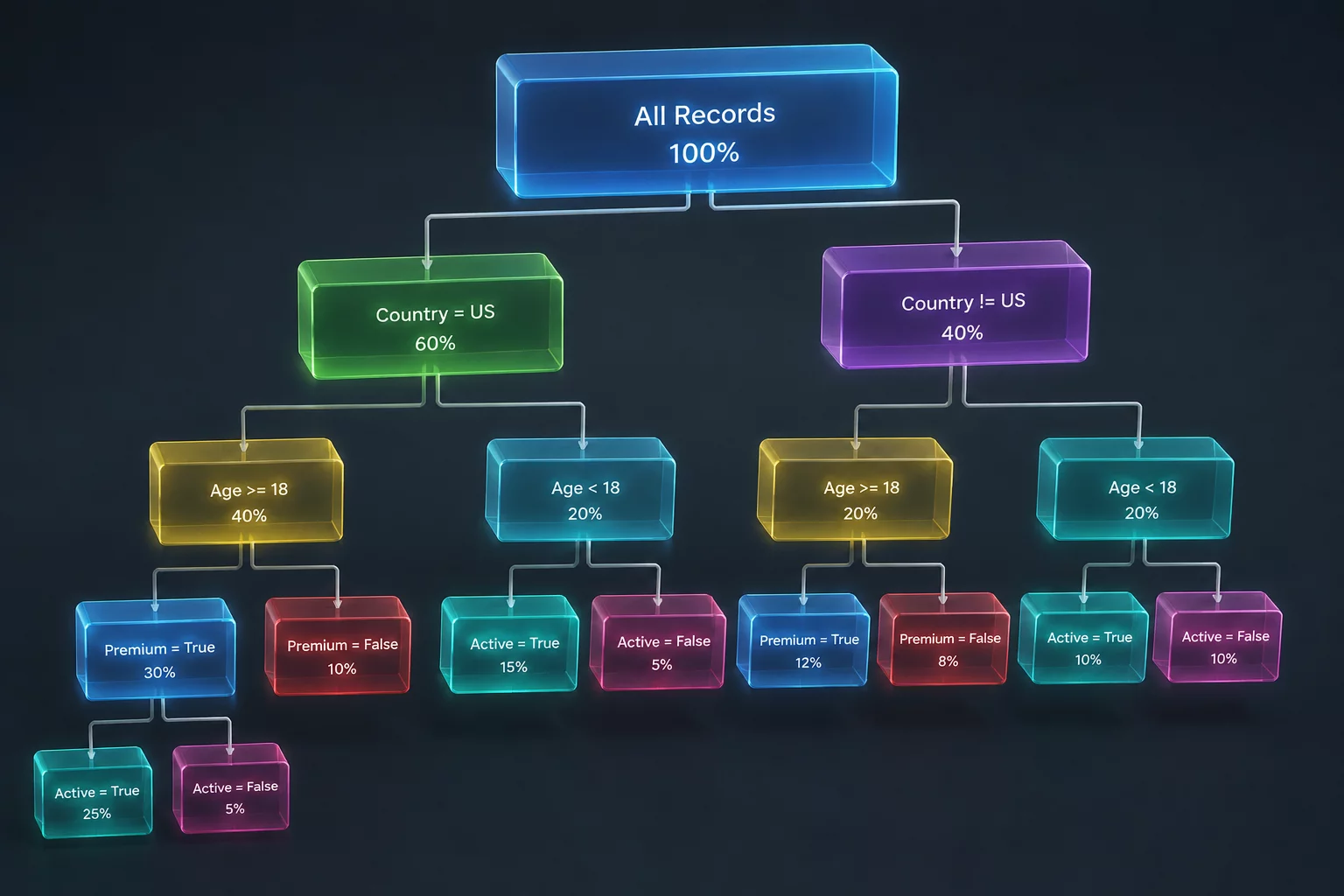
The Mathematical Impact of AND vs OR in Query Trees
Market screeners fail most frequently not from flawed indicators, but from careless Boolean structure. A single misplaced operator silently invalidates the entire research cohort.
When constructing multi-parameter queries, every AND statement establishes an intersection that aggressively shrinks the resulting candidate pool. In contrast, an OR operator executes a union, aggregating candidate subsets and frequently reintroducing unwanted noise into the sample. Screening engines evaluate these expressions sequentially unless explicit grouping rules guide the parsing sequence.
Without rigorous condition architecture, a screener intended to surface liquid trend-continuation candidates can inadvertently capture illiquid speculative instruments simply because an OR statement bypassed the baseline universe filters. Preserving the research question requires structuring operators to reflect exact analytical intent.
Evaluate Your Screener's Nested Logic Tree
Submit your current screener condition flow to test for operator precedence ambiguity, accidental sample widening, and redundant conjunctions.
Parenthetical Nesting and Precedence Traps
Most analytical screening engines default to standard mathematical precedence, resolving AND conditions before OR operations unless parentheses force a specific evaluation order. This default behavior produces widespread logic leakage when analysts mix regime requirements with setup triggers.
- Default Evaluation Order
- AND precedes OR
- Grouping Boundary
- Explicit Parentheses
- Risk of Unbounded OR
- Universe Contamination
- Ideal Clause Depth
- Max 3 Nested Levels
Consider an inquiry designed to detect liquid equities with either historical volume expansion or narrow consolidation bands. Writing Price > SMA AND Volume > 2x OR Volatility < 10th percentile will evaluate the first pair together, then append every low-volatility instrument in the universe regardless of price trend or liquidity. Enclosing the dual condition within parentheses restores the necessary intersection with base liquidity.
“A screener query without explicit nested grouping does not search for nuanced market phenomena; it searches for whichever clause the parser resolves first.”
Systematizing Complex Multi-Branch Screeners
Developing robust multi-branch screeners demands a systematic approach that isolates universe constraints from dynamic market observations. Dividing the query tree into distinct tiers ensures that baseline liquidity, structural regime, and localized catalysts never cross-contaminate.
By establishing separate container blocks for universe qualification and technical setup conditions, researchers prevent the parser from executing unintended unions. Each logical branch answers a specific portion of the core question before the engine aggregates the final result set.
Auditing Filter Trees Before Empirical Review
Before visually inspecting scanned charts or assessing candidate distribution, perform a dry-run Boolean audit. Isolate each branch independently to verify its standalone return count, ensuring that no single OR clause overwhelms the universe or masks failed underlying criteria.