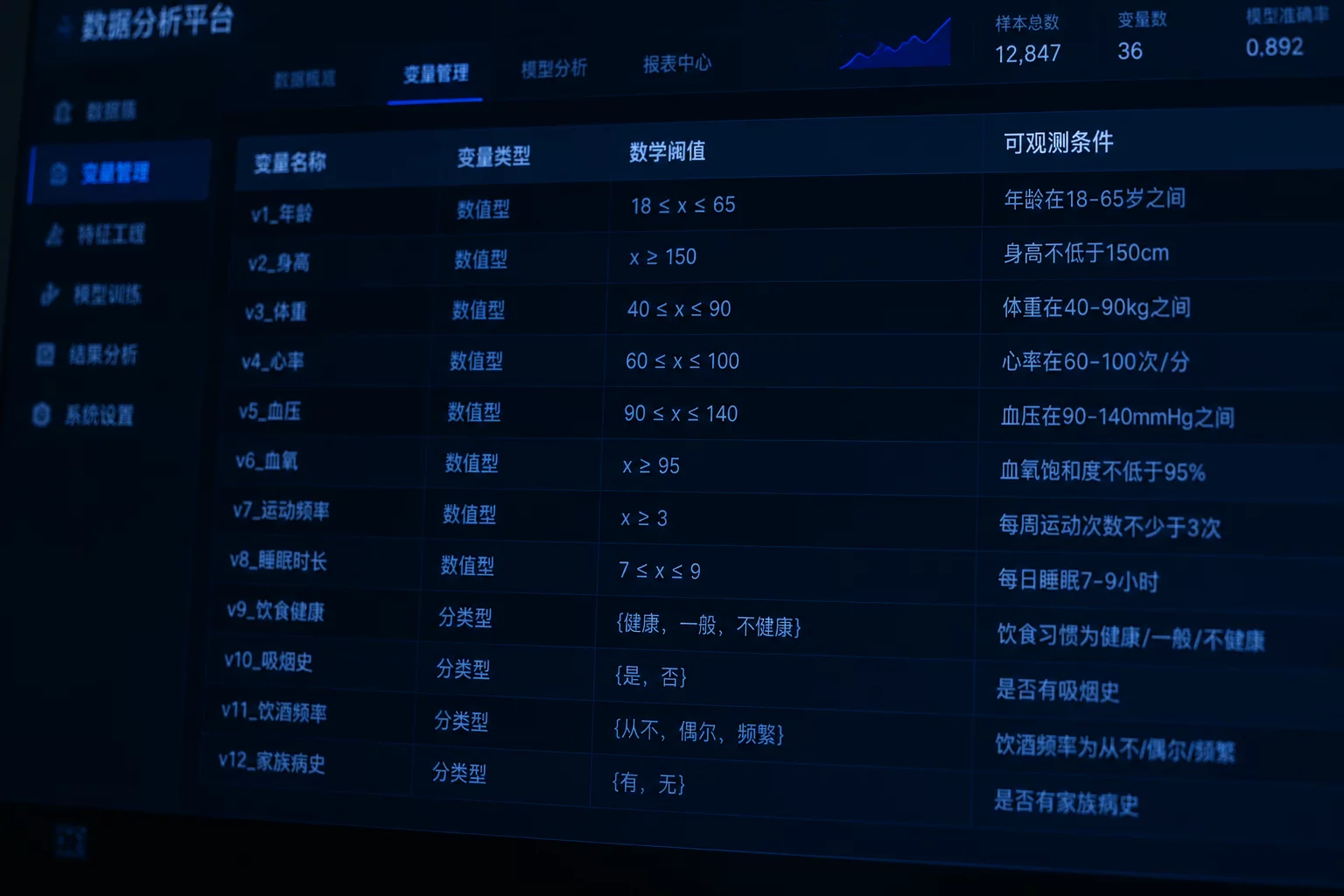
The Fatal Projection of Intent into Market Data
Analytical software parses numbers, not motives. Screener scripts evaluate whether numerical relationships hold true across a chosen historical window, completely blind to the sentiment or intent behind individual transactions.
Traders frequently describe candlestick configurations as institutional accumulation, aggressive distribution, or stealth absorption. The terminal database, however, stores nothing more than numerical trade prices, executed contract sizes, and timestamp strings. Imputing psychology, unobservable conviction, or predatory tactics to raw screener outputs mistakes a simple mathematical filtering step for an epistemological window into trader minds.
When translating market inquiries into actionable code, researchers must replace narrative speculation with concrete, observable criteria. A closing price crossing above a fifty-day simple moving average marks a verifiable statistical event. It does not establish that fund managers are preparing a multi-quarter position.
Formulate Precise Criteria for Your Query
Review systematic techniques to separate observable statistical properties from qualitative market assumptions before programming screener logic.
Dissecting Observable Inputs from Narrative Assumptions
Every programmatic screener functions as a deterministic logic gate. Scanners cannot assess whether market participants are defending a support level, simply because defensive effort lacks an objective mathematical definition. Instead, the screener computes whether the bar's lowest price exceeded an arbitrary threshold formula over twenty consecutive trading days.
- Narrative Construct
- “Institutional Accumulation”
- Observable Syntax
- Volume > 150% 50-SMA & Close > Open
- Error Risk
- Prescriptive Attribution Fallacy
- Verification Method
- Manual Post-Scan Inspection
Confusing the narrative shorthand with the underlying arithmetic causes researchers to overestimate the predictive scope of their scanning routines. A sudden expansion in daily trading volume with compressed price spread may indicate automated portfolio rebalancing, option expiry adjustments, hedging operations, or clerical routing just as plausibly as intentional institutional accumulation.
“Screener filters do not inspect why an order crossed the tape; they merely verify that the recorded digits satisfied a mathematical inequality.”
Structuring Queries Around Measurable State Changes
Defensible screener construction demands that queries rely exclusively on audited data columns: historical prices, reported trading volumes, floating share counts, and regulatory filing statements. Criteria based on unrecorded assumptions cannot be calibrated or reproduced across independent testing runs.
By confining screener logic to verifiable parameter thresholds, researchers build query pipelines that remain robust through varying market conditions. A candidate instrument lands in the resulting list solely because its quantitative metrics fulfilled the Boolean rule set, leaving subjective interpretations for the subsequent manual review stage.
Operational Checklists and Query Sanitation
Prior to activating any automated scan, run each condition through a rigorous verification checklist. Confirm that the required values stem directly from standardized feed variables. Check that the descriptive label on your screener tab clarifies the mathematical transformation rather than an assumed market mood. Ensure that boundary limits represent quantifiable sample distributions rather than arbitrary convictions.