Why Pre-Filter Boundary Conditions Determine Screener Quality
A quantitative screener scanning for breakout patterns across an unconstrained universe will inevitably populate its results with thinly traded penny instruments, illiquid reverse-merger vehicles, and erratic quotation spreads.
Screening criteria evaluate mathematical relationships between prices and volumes, yet these formulas are completely indifferent to the physical reality of transaction costs. When an algorithm scans an uncurated equity universe, a fifty-share purchase that shifts a micro-cap ticker by four percent registers as high momentum. Unless explicit boundary conditions remove such issues beforehand, the resulting candidate pool reflects execution impossibilities rather than genuine institutional participation.
Many analysts attempt to fix this issue by stacking additional technical indicators, believing that tighter relative strength or momentum bounds will filter out noise. In reality, indicator stacking fails because the problem resides in universe composition, not signal syntax. Defining non-negotiable boundaries upfront ensures that every surviving instrument possesses sufficient market depth to support valid price discovery.
Need Guidance Structuring Boundary Filters?
Send research questions or screener logic inquiries to our independent editorial review team for pedagogical feedback.
Calibrating Capitalization Floors and Liquidity Measures
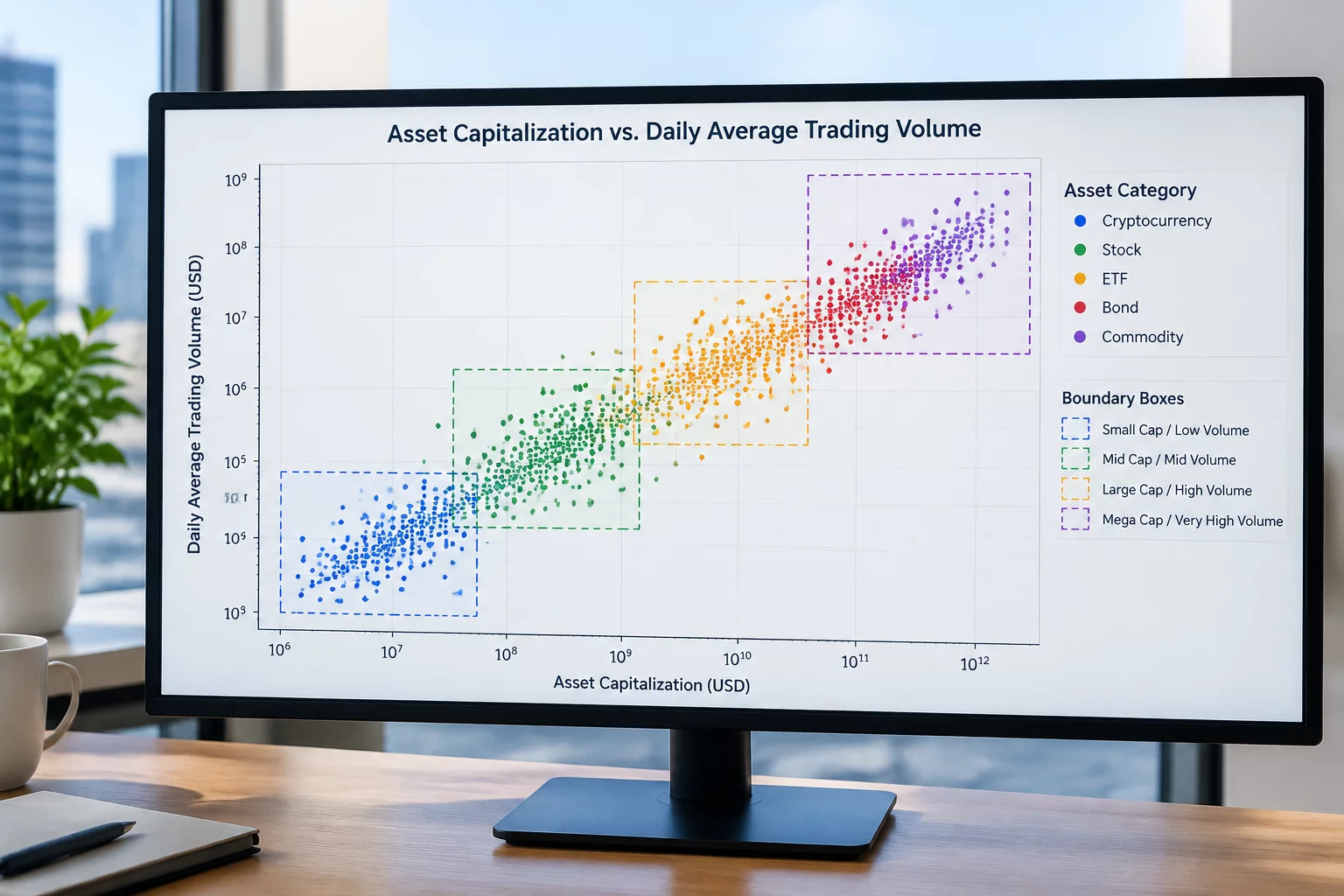
Effective boundary conditions require measuring liquidity through dollar turnover rather than raw share count. Trading 200,000 shares of a three-dollar stock represents merely $600,000 in turnover, whereas 200,000 shares of a seventy-dollar stock reflects $14,000,000 in turnover. Relying solely on share volume systematically biases screeners toward low-priced, high-volatility names with wide fractional bid-ask spreads.
- Capitalization Floor
- > $300M (Small-Cap+)
- Turnover Floor (50-Day ADTV)
- > $5.0M / Day
- Minimum Share Price
- > $5.00 / Share
- Spread-to-Price Cap
- < 0.25% Average
Establishing these minimum benchmarks protects downstream filters from distortions. Technical oscillators calculated on assets with wide bid-ask spreads frequently show false divergence simply because consecutive transactions alternate between the bid and the offer. Removing these names isolates genuine supply and demand shifts.
“If you must invent three supplementary technical rules just to keep penny stocks out of your scan, your boundary condition failed before the scan even ran.”
Common Fallacies in Liquidity Boundary Implementation
A frequent implementation trap involves using short-term simple moving averages to enforce liquidity thresholds. When an obscure corporate announcement triggers an unprecedented one-day surge in a dormant ticker, that single spike inflates a ten-day average volume metric, granting temporary universe entry to a structurally illiquid security.
To guard against transient volume spikes, robust screener logic pairs longer-term smoothing intervals with rolling median turnover or percentile constraints. Such formulations require sustained, repeatable volume before an asset is admitted into the evaluative pipeline.
Systematic Integration into Scanning Syntax
In platforms such as thinkorswim Stock Hacker or custom Python research scripts, boundary conditions should always occupy the topmost boolean condition block. By placing capitalization and liquidity filters at the outer wrapper, the screening engine discards non-qualifying instruments early, optimizing execution speed and delivering clean candidate sets ready for visual manual review.