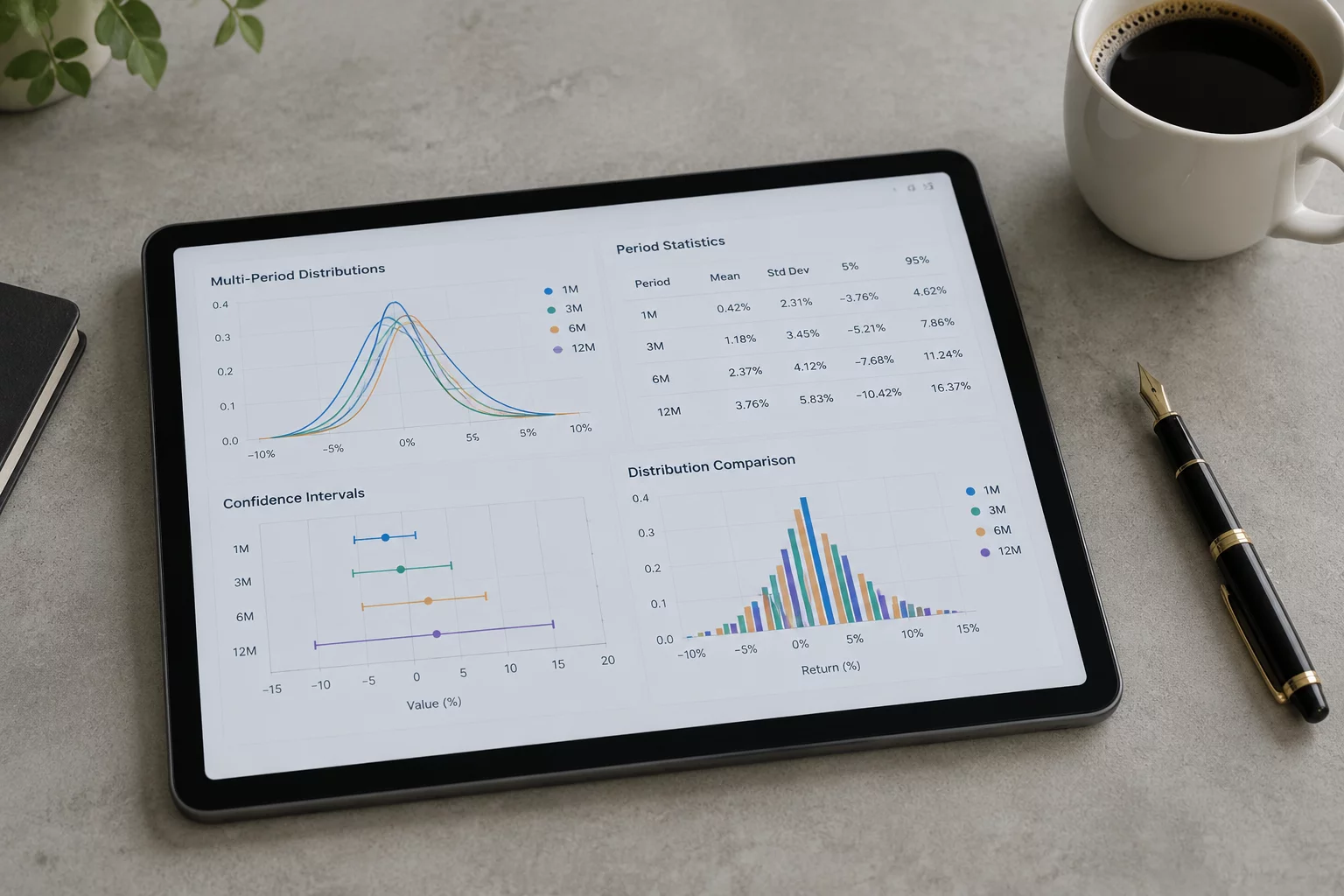
The Silent Temporal Premise in Every Screener Rule
A market screening condition is never temporally agnostic; it continuously registers quantitative events across an explicit or implicit observation span.
Analysts frequently formulate inquiries such as “Which instruments display unusual volume expansion?” without stating whether that expansion must persist over twenty trading sessions, three consecutive quarters, or a single thirty-minute bar. The query appears self-contained on paper, yet its mathematical manifestation demands a specific lookback horizon. If the inquirer fails to state that duration explicitly, the default aggregation parameter of the charting terminal or screening engine silently dictates the result.
This oversight introduces severe observational drift into research cohorts. When an inquiry designed to evaluate secular accumulation evaluates volume against a twenty-day moving average, it captures ephemeral earnings surges instead of institutional repositioning. The question intended to capture one market phenomenon, while the screener code captured an entirely different physical event simply because the temporal boundaries remained unarticulated in the initial thesis.
Does Your Research Question Define Its Observation Window?
Audit your screening hypothesis against temporal leakage and mismatched lookback intervals before writing code.
Deconstructing the Mechanics of Lookback and Holding Windows
Every systematic inquiry operates across four interrelated time horizons: historical baseline, sampling frequency, trigger window, and hypothesis persistence. The historical baseline establishes the statistical norm against which deviations are evaluated. The sampling frequency dictates bar granularity, ranging from intraday prints to quarterly balance sheets. The trigger window determines how long conditions must satisfy criteria. The persistence window defines the realistic lifespan over which the observed condition remains relevant for manual review.
- Lookback Horizon
- Historical baseline window
- Aggregation Interval
- Bar period (1m to 1W)
- Persistence Window
- Condition duration count
- Decay Expectation
- Hypothesis validity span
Ignoring these explicit distinctions leads directly to indicator misapplication. For instance, a screener combining a 14-period RSI computed on daily bars with a 200-day moving average pairs two completely distinct analytical horizons. One measures immediate two-week momentum displacement; the other measures an annual structural mean. Without a deliberate research justification explaining how these horizons interact, the query produces an accidental hybrid that answers neither question cleanly.
“When a query omits the temporal baseline, the screener's default aggregation dictates the answer rather than the analyst's intellectual premise.”
Resolving Horizon Contradictions Across Multi-Metric Scans
Complex screening models frequently stack criteria from different operational layers. A macro filter might isolate instruments trading above their 40-week exponential baseline, while an execution filter isolates those breaking yesterday’s high on twice their average hourly volume. Stacking them is completely legitimate, provided the researcher establishes a coherent hierarchy between context and trigger.
The principal pitfall occurs when conflicting horizons neutralize one another without the researcher realizing it. Demanding that an asset demonstrate multi-month price consolidation alongside explosive three-day volatility will yield an empty result set during stable regimes and erratic outliers during market shocks. Defining each horizon beforehand makes it possible to separate regime qualification from short-term anomaly detection.
A Systematic Pre-Scan Checklist for Horizon Integrity
Before translating any inquiry into scanner scripts, run a four-point horizon verification. First, verify that every metric states its lookback period in calendar days or bar counts rather than ambiguous terms. Second, confirm that all aggregated technical fields align with the same temporal resolution unless a multi-timeframe engine is deliberately configured. Third, calculate the expected halflife of the screener output to ensure manual review occurs before the observation decays. Fourth, test edge cases where sudden weekend market closures or session holidays distort rolling calculation windows.