Why Writing Screener Code First Distorts Market Logic
Screening tools invite quick typing, yet jumping directly into script interfaces invariably substitutes platform convenience for disciplined market observation.
Most market participants open a query engine with a loose conceptual intuition such as institutional participation or compression. Instead of clarifying what observable traces those conditions leave behind, they immediately scan the dropdown menus for pre-built functions like moving average crossovers or stochastic indicators. In that moment, the research inquiry changes from an exploration of market phenomena into whatever arbitrary mathematical parameters the platform makes easiest to calculate.
When you start with syntax, the technical constraints of the script dictate your thinking. You cease asking what is actually occurring across transactions and instead begin asking what the editor will compile without errors. Avoiding this trap requires establishing a strict procedural firewall between conceptual inquiry, observable event definitions, and eventual implementation in code.
Submit Your Query Blueprint for Methodological Feedback
Have your research questions and observable criteria decoupled from syntax through our academic peer review desk.
Translating Abstract Hypotheses into Hard Data Footprints
An observation is neither an opinion nor a narrative. It is a discrete, measurable event recorded in public market data that any two independent researchers would identify identically without subjective debate.
- Physical Dimension
- Price, Volume, Time, Count
- Baseline Comparison
- Rolling Median vs Prior Cohort
- Temporal Persistence
- Multi-bar duration condition
- Observer Invariance
- 100% deterministic evaluation
Consider the difference between stating that an equity displays quiet accumulation and stating that its twenty-day average true range has contracted below its prior sixty-day interquartile range while weekly turnover remains in its upper third. The first phrase cannot be scripted faithfully because it embodies speculative intent. The second phrase describes verifiable footprints across order transactions that remain invariant regardless of what screening language you eventually write.
“If you cannot draw your observation clearly on a blank napkin using only price bars and volume columns, typing code will merely automate confusion.”
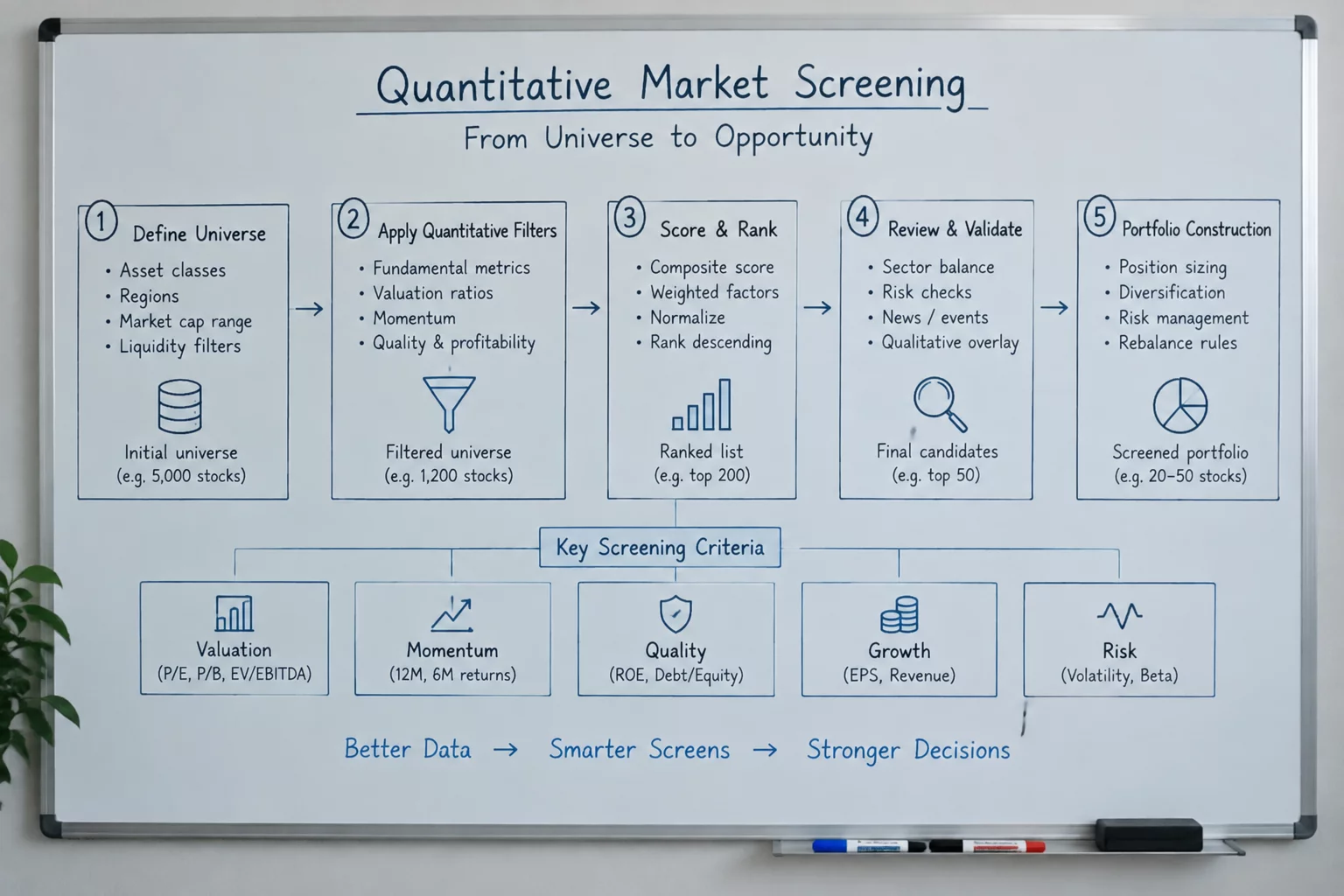
The Sequential Path from Phenomenon to Syntax Expression
Methodological hygiene relies on maintaining sequential steps where each milestone must be completed and documented before the next phase begins.
By enforcing this separation, any engine limitation becomes clearly exposed. If a specific platform syntax cannot compute relative historical percentiles without severe lag or simplified approximations, you recognize immediately that the screener is compromising your observation, rather than naively accepting flawed output as an accurate market reading.
Eliminating Platform Artifacts and Code-Induced Blind Spots
Every screening syntax carries built-in assumptions: how it handles non-trading periods, how moving aggregates handle corporate actions, and whether bar close values look forward into the current settlement period. When the observation is defined before code selection, auditing these artifacts becomes straightforward.